Christmas Surprise
To say that this Christmas season was full of surprises would be an understatement, but I definitely wasn’t expecting the one that came on Christmas morning.
 We rose early to catch the sunrise on the eastern shore of Sanibel Island. Seashells are abundant there so we were busy picking them
  up both before and after sunrise. It was also great to wish a merry Christmas to the passersbys, including a family from Holland.
 The weather was cool, the sky was mixed with sun and clouds, and the sea breeze blew steadily.
  Despite the cooler temperatures–or possibly because of them–many of Sanibel’s wintering birds were
 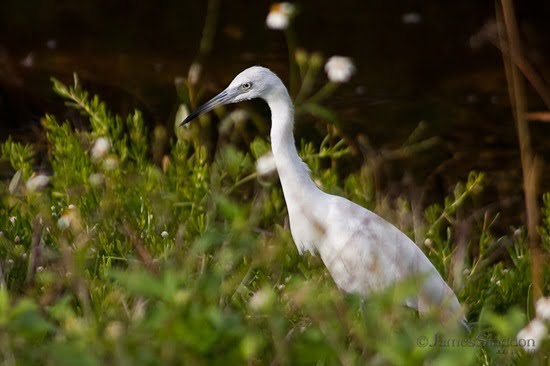 present on the island. The day before, we had taken Wildlife Drive and seen the White Pelican, Reddish Egret and a Little Blue
 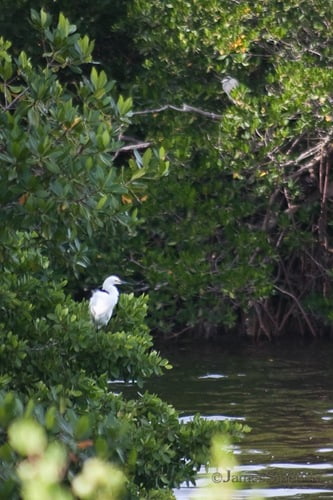 Heron which, because of it’s young age, was actually all white. Most of all I was glad to set my sights on a Yellow-crowned Night-heron. It was the
 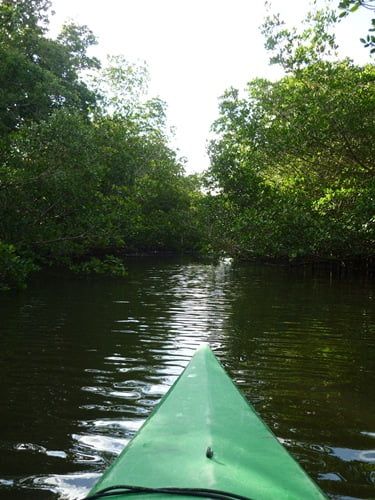 only North American heron I hadn’t seen yet! Many more sightings of this exquisitely-patterned species were to follow during our expedition in the kayaks but the first sighting was memorable for us.
Now about Christmas morning. Even in the hour following sunrise it remained cool, almost cold. The only reason I didn’t notice the  temperature was because of how interesting the terns were. Both Sandwich Terns and Royal Terns performed their aerobatic stunts not far out at sea and, even though I couldn’t see their beaks very well with the way they faced away from me into the wind, a positive identification was possible later thanks to James’ photos.
 Then, once, as I was attempting to follow the zigzagging terns through the scope I saw that, in the distance, were many birds I hadn’t seen because they were so far out to sea. Amidst the other birds that looked like common cormorants and pelicans was one very different kind. Overall it was white. In the wings it had some black, distinct inky black. As I followed
 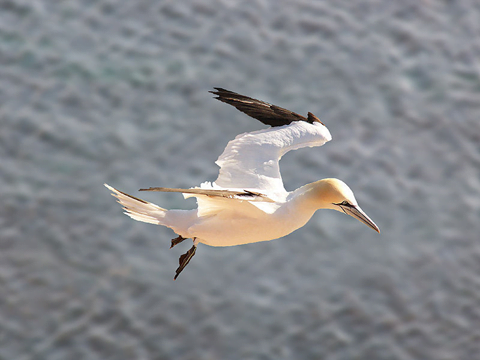 it I could tell that the black was restricted to the ends of each wing, not spread along the entire trailing edge as in the Wood Stork or White Pelican. That was strange. “Northern Gannet?” I thought. Hmm. Before it disappeared I saw that behind it, whether feet or tail, something projected longer than usual and the neck and head seemed neither long nor short.
 When I consulted Peterson’s guide however, everything made sense. It was none other than the Northern Gannet, wintering in the south, a true seabird and my first one at that. It was great to have a positive sighting—right from the beach! I must give God the credit for one more wonderful Christmas present.
“Ask, and it shall be given you; seek, and ye shall find, knock, and it shall be opened unto you: for every one that asketh receiveth; and he that seeketh findeth; and to him that knocketh it shall be opened. … Your Father which is in heaven [shall] give good things to them that ask Him” (Matthew 7:7–11).
That’s exciting. It’s always fun to make a new identification, but it was especially amazing how God brought them to your attention and gave you just enough of a sighting to tell exactly what they were!